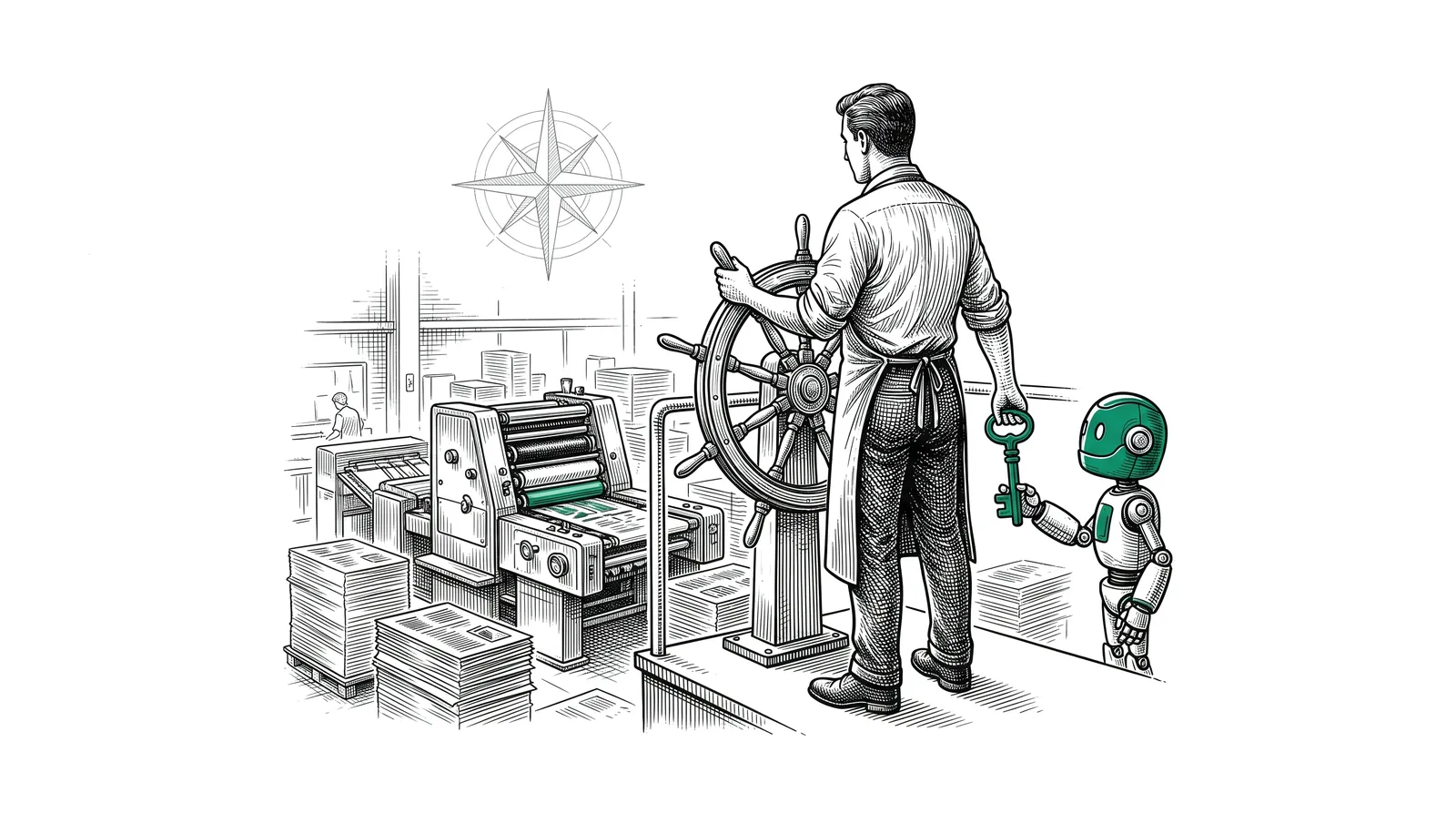
Almost every printing company is trying something with AI today. An assistant that reads quotes or a pilot with the planning. Yet in many companies you see little of it in the figures. The difference rarely lies in the technology. It lies in how you steer. That is called AI governance.
Why governance?
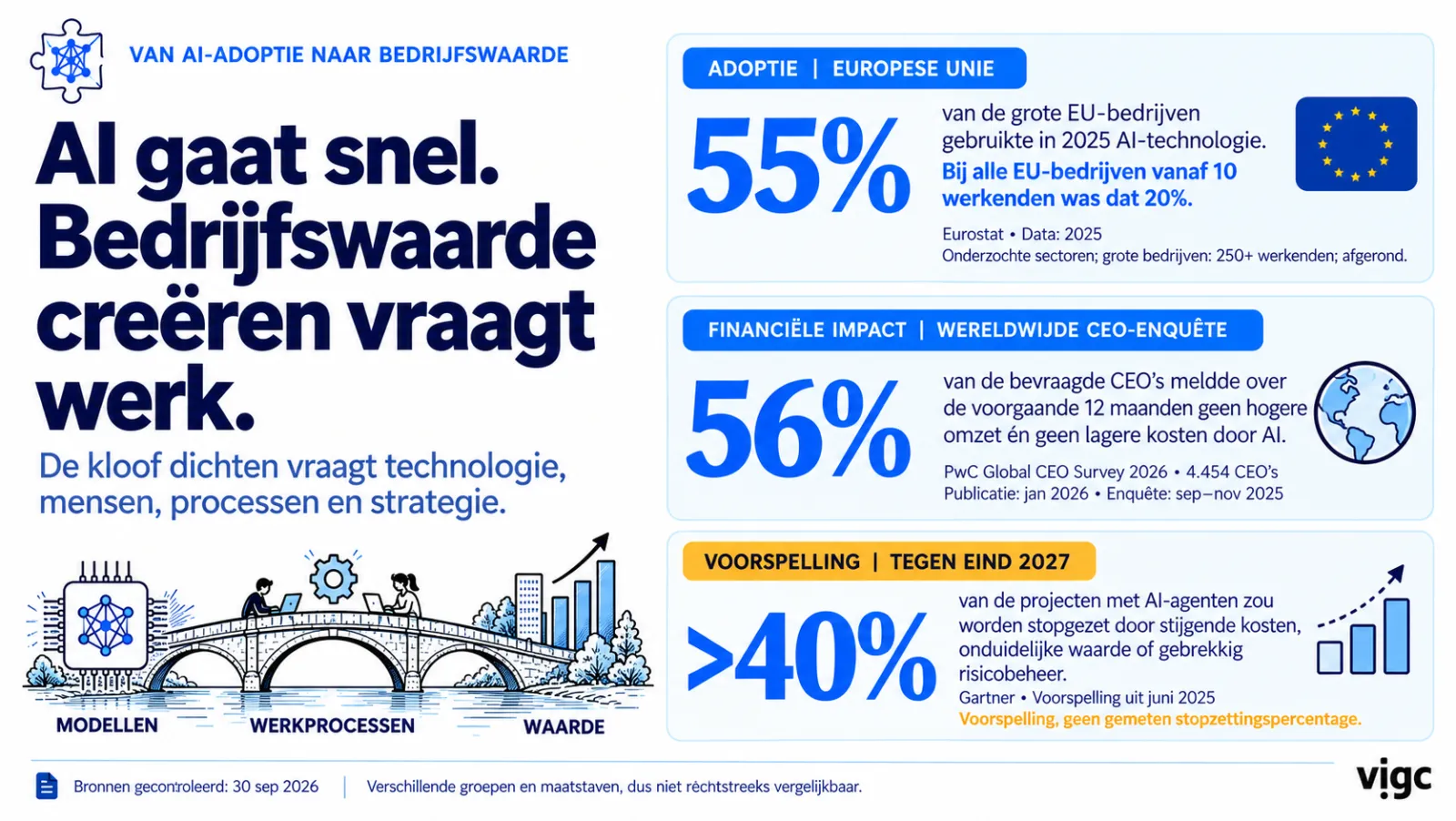
AI moves fast. Creating business value takes work.
European companies use AI more and more. Large companies lead the way, small ones follow more slowly. At the same time a majority of business leaders say AI has not yet brought them higher revenue or lower costs. The figures below are measurements from surveys and statistics.
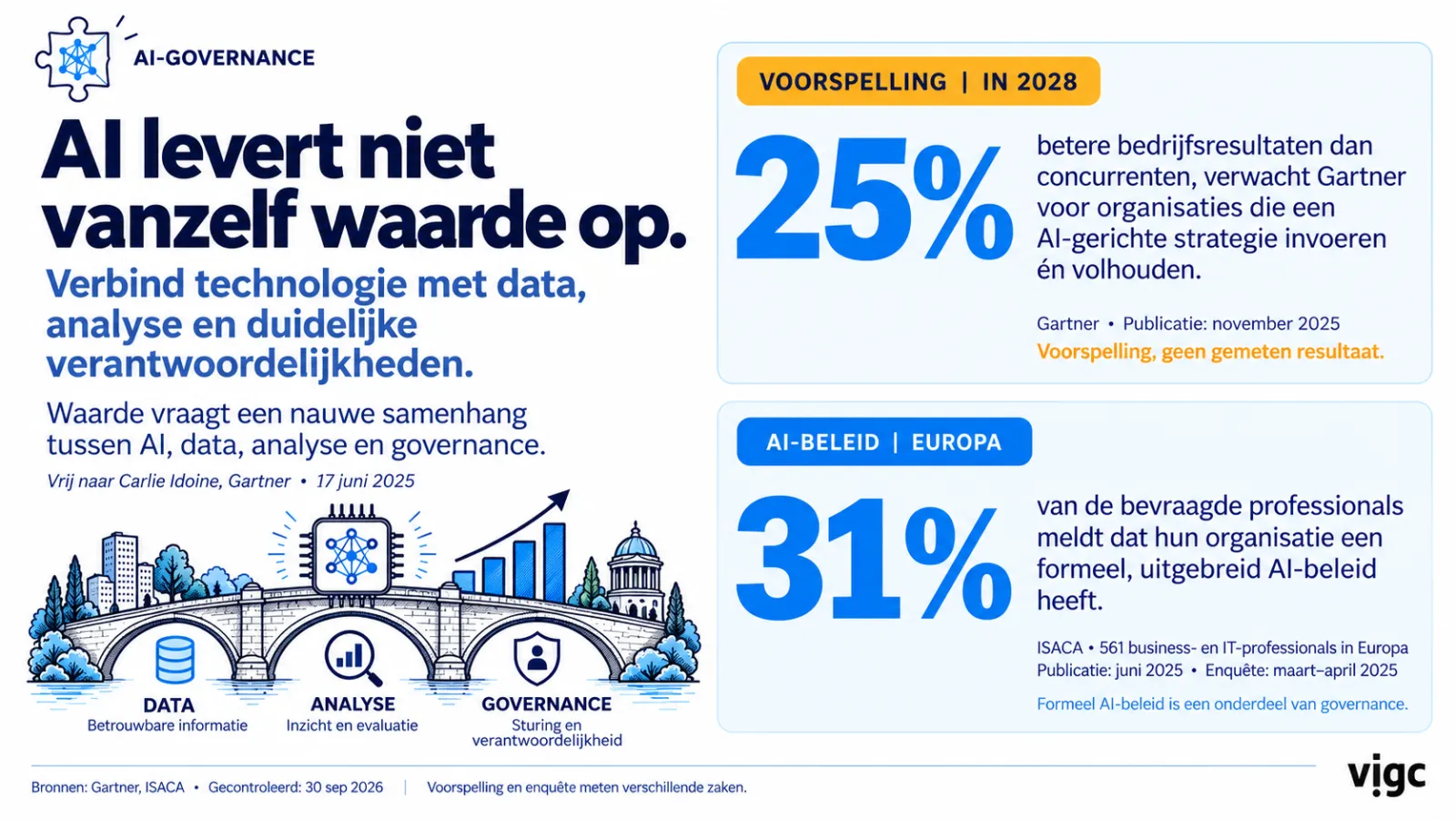
Research firm Gartner looks ahead. Two predictions are worth remembering for a printing company.
Read the figures with care. They come from different groups and measure different things. You cannot compare them directly. The pattern is clear though: adopting AI is easy, getting value out of it is the real work.
What governance is in a printing company
Governance sounds like something for large companies with a legal department. In a printing company it is about ordinary questions: who decides what AI may do and how do you know whether it works?
Gartner describes value as a bridge with pillars. AI alone does not carry that bridge. In a printing company the pillars look like this.
| Pillar | What it means | In your printing company |
|---|---|---|
| Data | Reliable information | Orders and machine data that are correct and that you can find again. An AI running on messy data gives messy answers. |
| Analysis | Insight and evaluation | You measure whether it works. How much time does the assistant really save? How often is it wrong? |
| Governance | Steering and responsibility | Someone owns every AI application. It is written down what is and is not allowed. |
A one-page AI policy
A formal AI policy is one part of governance. For an SME that does not have to be a thick document. One page everyone knows works better than a binder nobody reads. Answer these questions.
Which AI tools do we use and with which account? A business account or a private account makes a big difference for your data.
What never goes to a public AI? Think of customer files and personnel data.
Every application gets the name of a person. That person follows up whether it works and talks to the users.
Where may AI make proposals and where does a human always decide? Set that down per process.
Choose one figure per application that you track, such as time saved or the number of errors.
Agree in advance when you stop a pilot. That saves a lot of discussion later.
Do you work with sensitive documents? Then also read guide 11 on local AI. There your data stays within your own walls.
Start with a goal
A good AI project starts with a clear question: do you want to learn something or do you want to solve something?
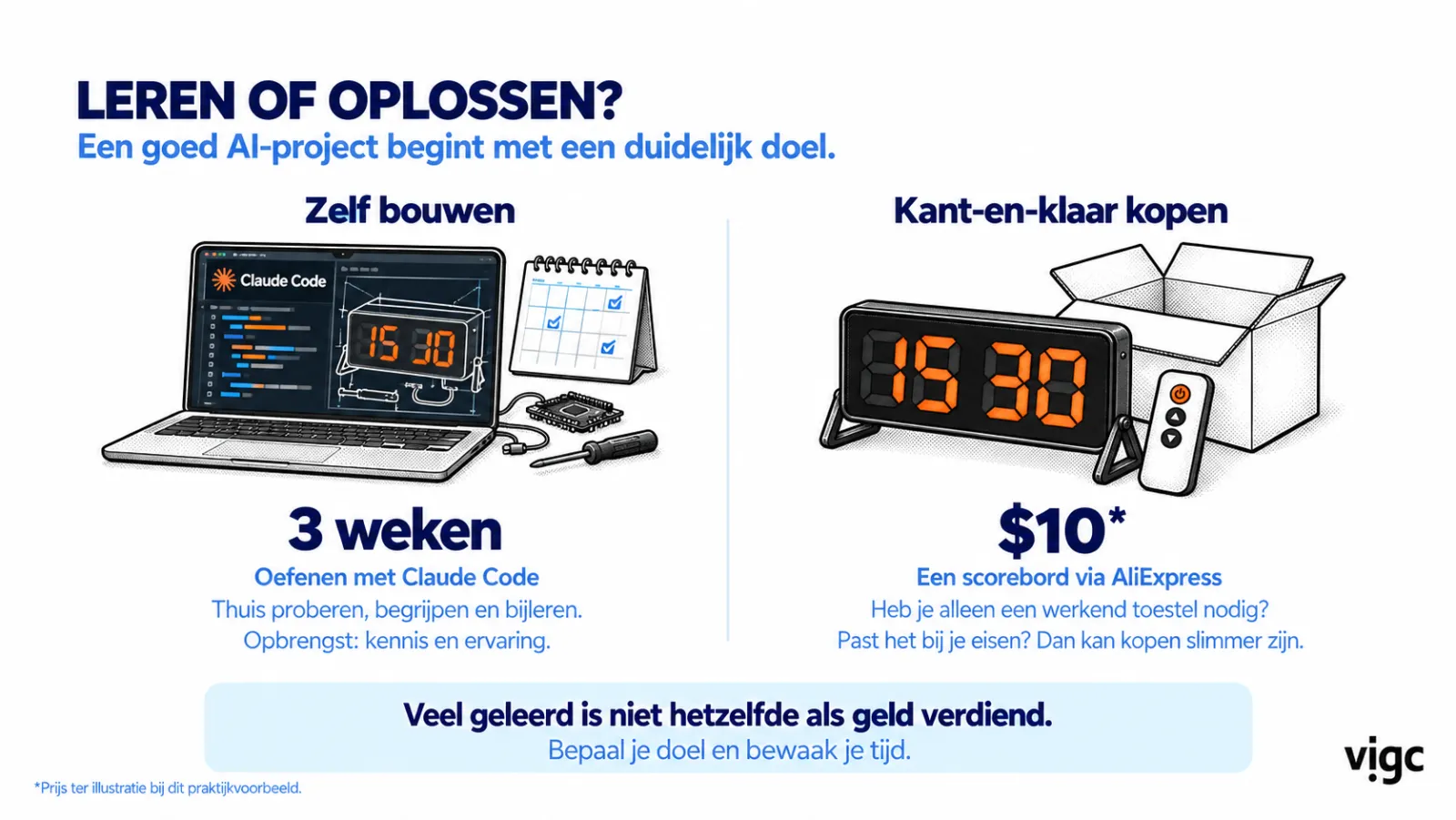
The example comes from practice. Someone built a scoreboard themselves with AI in three weeks. The same device exists ready-made for about ten dollars. Was that wasted time? Not if the goal was learning. It was if the goal was a working scoreboard.
The goal is learning
You want to understand how AI works and what it can do. A pilot may then take long and fail. The return lies in what your team now knows.
The goal is solving
You have a problem that has to go. Then first check whether something exists that you can buy. Does it fit your requirements? Then buying is often smarter.
Having learned a lot is not the same as having earned money. Write down the goal before you start. Agree how much time you spend on it and guard that time.
Start small
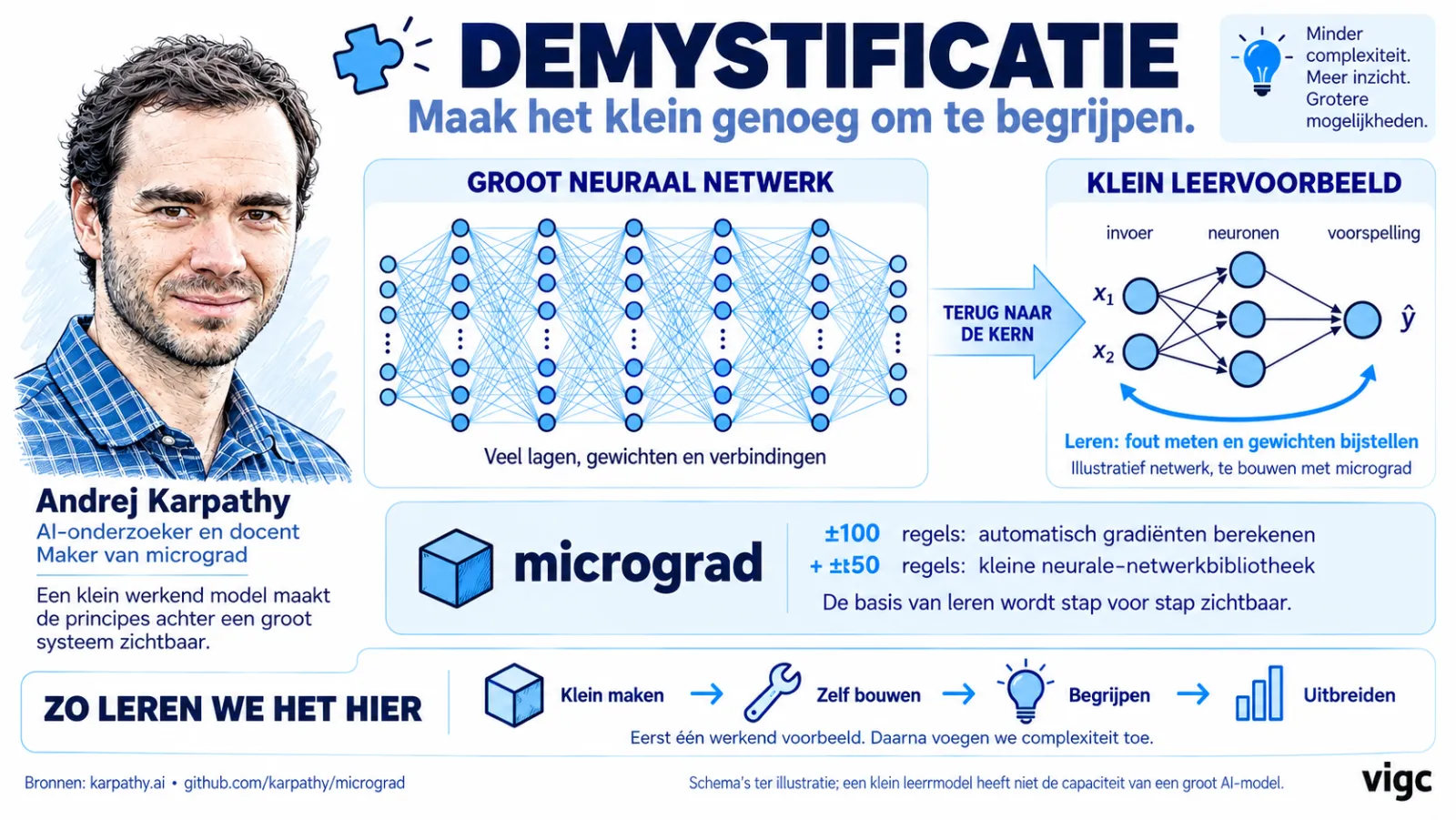
A small agent with a small task gives a visible result. Get one component working first. Test it and understand it. Then expand.
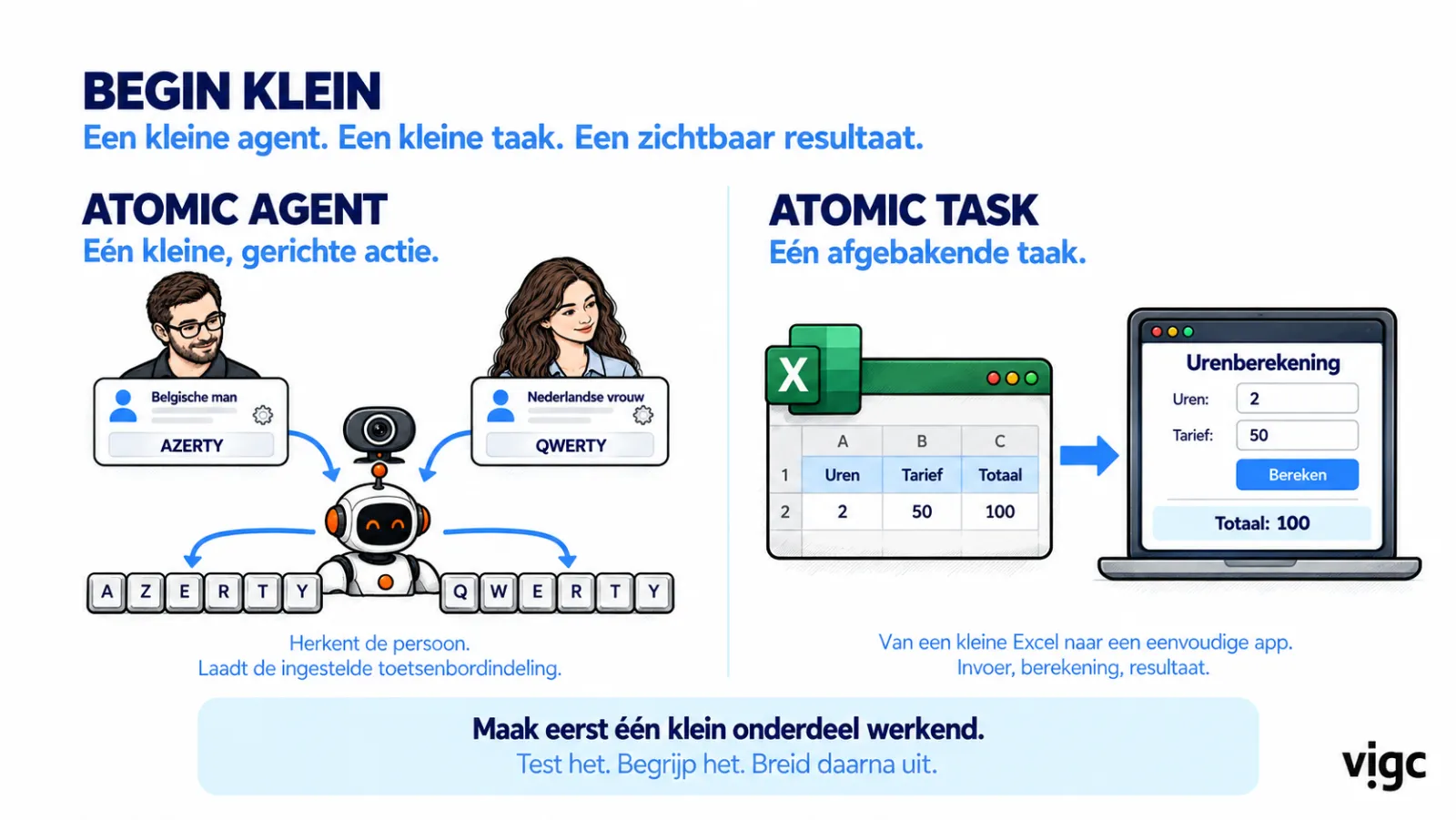
An agent that does one thing. It recognises who is at the computer and loads the right keyboard layout. Nothing more. That way you can test it and you know exactly what it is allowed to do.
A task with a clear beginning and end. A small Excel file with hours and rate becomes a simple app. You enter hours and rate and see the total. In a printing company that could be a quick price check for a standard product.
Not everything is AI
A lot of work in a printing company follows fixed rules. You do not need AI for that. A script or ordinary automation does it faster and cheaper. It also does the same thing every time. AI is strong where language and context play a part.
| Automation and scripts | AI | |
|---|---|---|
| Works with | Fixed rules and steps | Language and context |
| Example | “Order number missing? Put the order on hold.” | “The same flyers as last time, but twice as many.” |
| What it does | Executes what was set down in advance | Proposes data, an employee checks it |
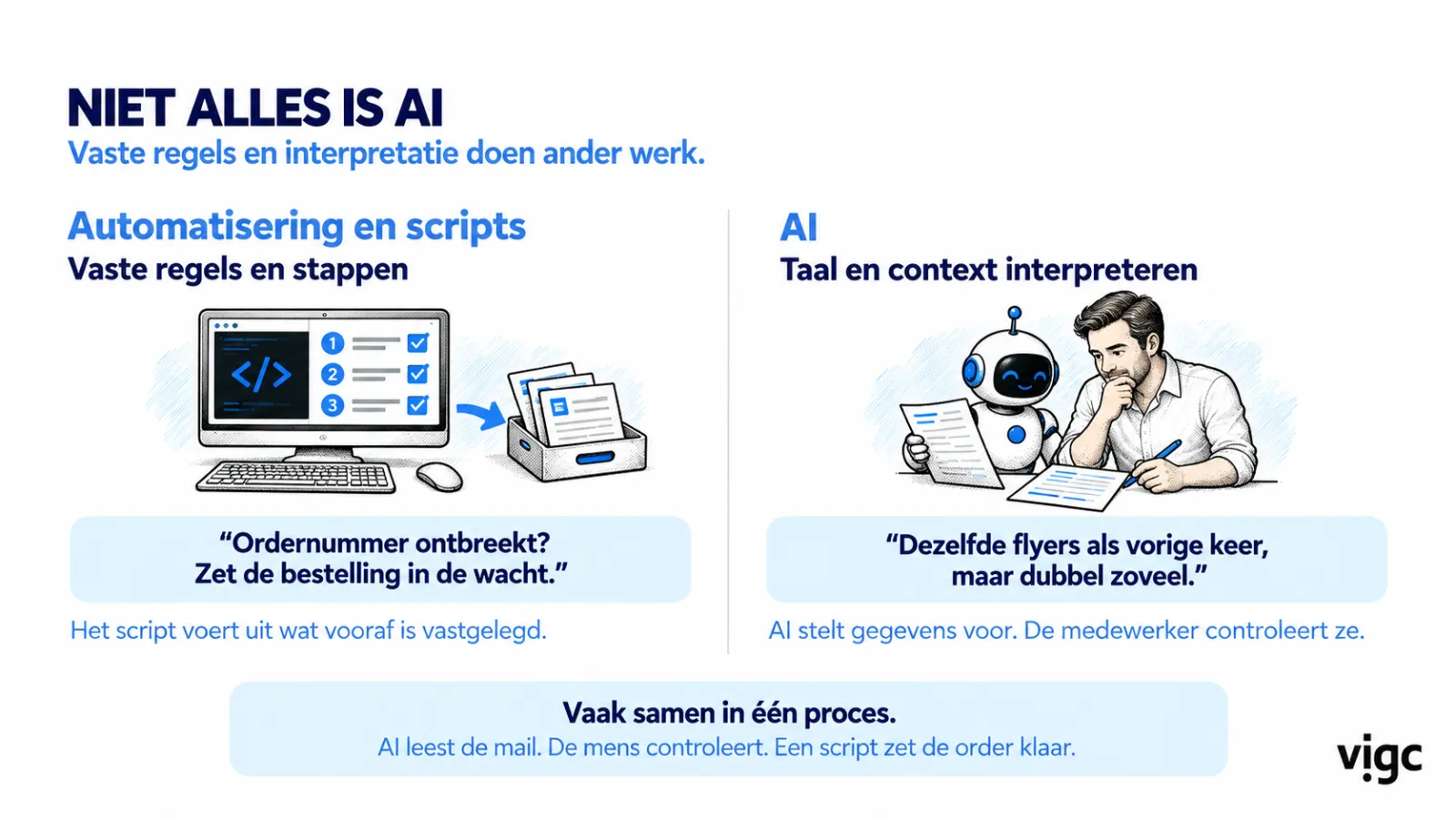
In practice they work together. AI reads the customer's email. An employee checks what the AI made of it. Then a script prepares the order in your system. Whoever knows that distinction keeps their AI project small and affordable.
People in the loop
AI prepares. People check and decide. That is called human in the loop.
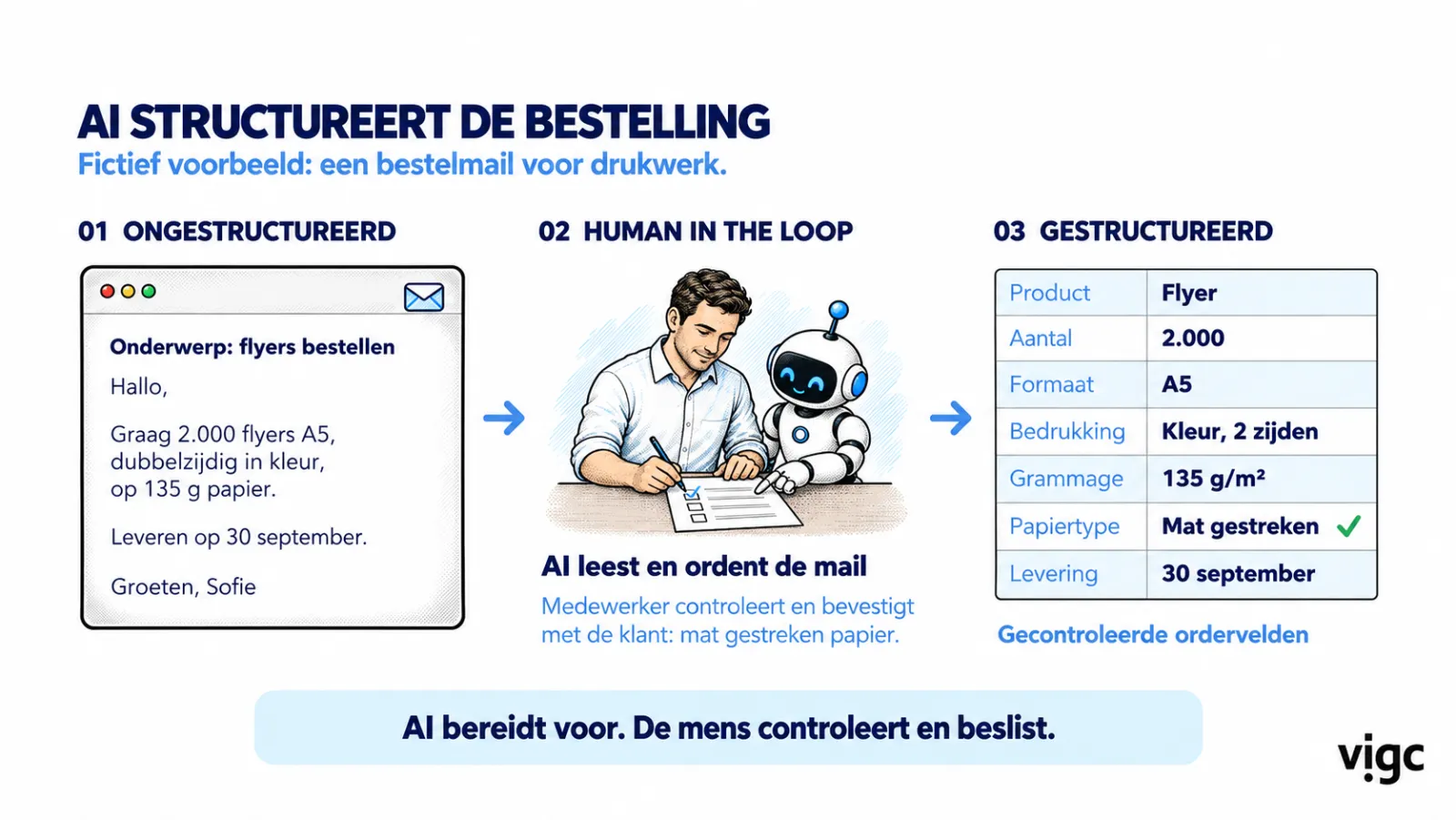
Take an ordinary order email. A customer asks for 2,000 A5 flyers, double-sided in colour, on 135 gsm paper. The paper type is not mentioned. This is how it goes with a human in the loop.
Free text, the way customers write. No form and no fixed order.
The AI puts product, quantity, format, printing, grammage and delivery date into order fields. It flags what is missing.
They see that the paper type is missing and check with the customer: matt coated.
Only after that check does the order move on. The responsibility stays with the employee.
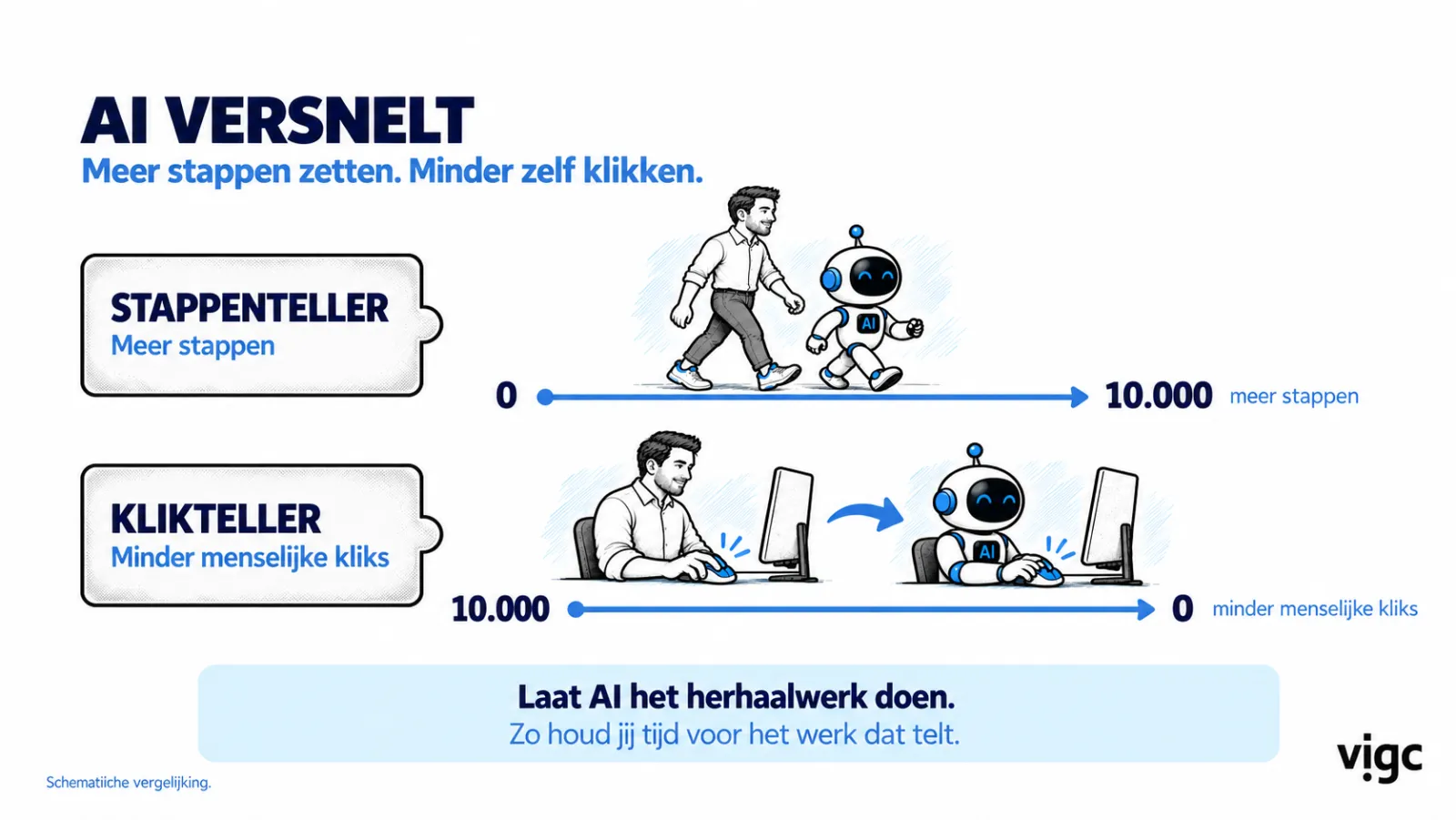
The advantage lies in the division of work. AI does the repetitive work: retyping and organising. The employee keeps time for the work that counts. Talking to the customer and deciding.
Rule of thumb: the higher the stakes, the closer the human stands to the decision. AI may produce a summary of log entries on its own. A price to a customer or an order to the press is always approved by a human.
From pilot project to scale
Many AI projects get stuck in the pilot phase. A well-considered step-by-step plan helps to break through that phase.
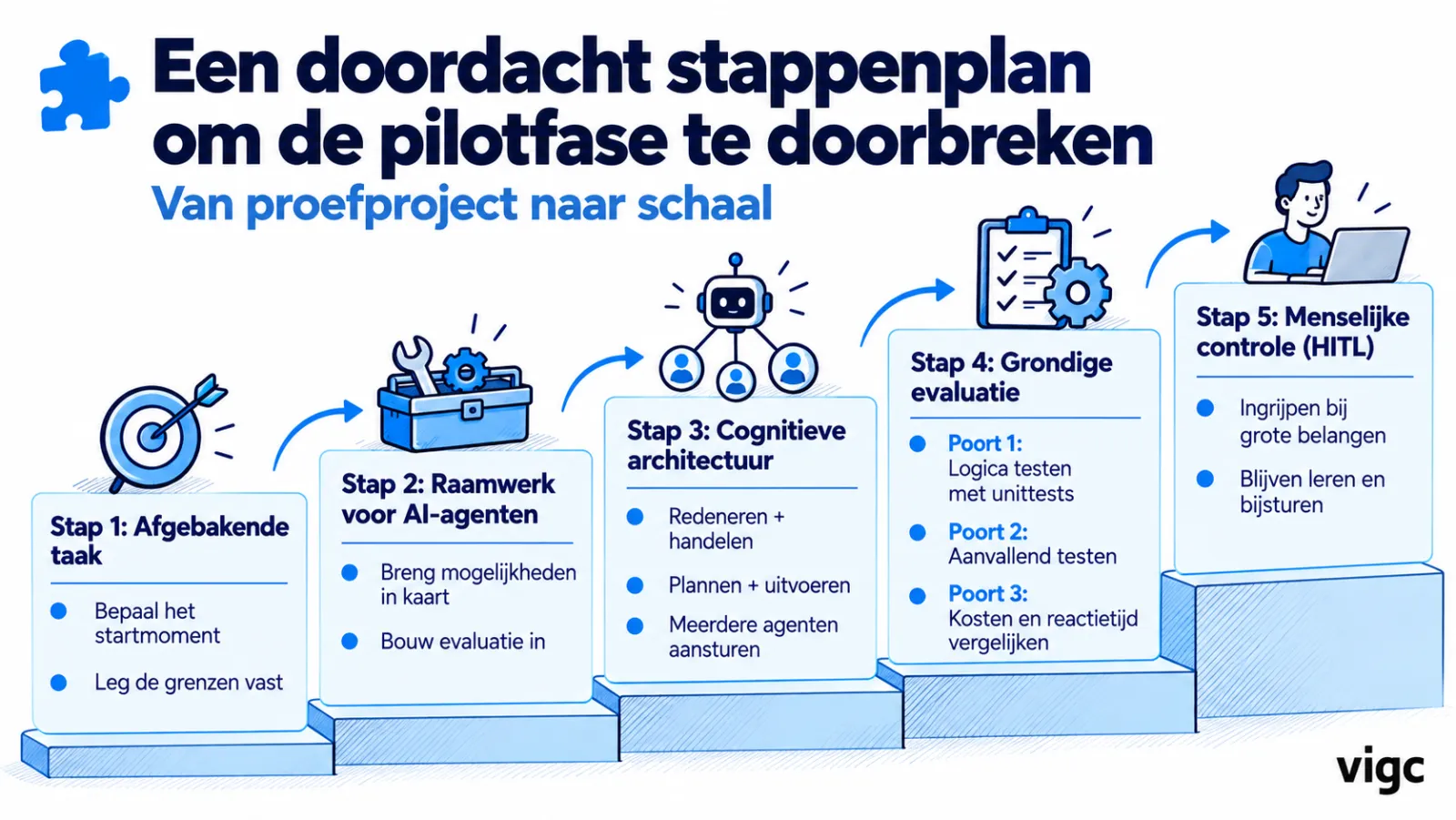
Determine when the task starts and set the boundaries. What does the AI do and what does it not do?
Map out what the agent must be able to do. Build in the evaluation right away, not afterwards.
How does the system think and work? Reasoning and acting, planning and executing. Sometimes one agent directs other agents.
The system only moves on once it passes the gates below.
A human steps in when a lot is at stake. The team keeps learning and adjusting. This is known as HITL: human in the loop.
The three gates of a good evaluation
| Gate | What you test | Question for your printing company |
|---|---|---|
| Gate 1 | The logic, with fixed test cases | Does the assistant give the right order fields every time for ten known order emails? |
| Gate 2 | Adversarial testing | What does it do with an unclear email, a joke or an email that makes it do something else? |
| Gate 3 | Comparing cost and response time | What does a processed email cost and how long does it take? Is that better than today? |
Gartner predicts that more than four in ten projects with AI agents will be cancelled. Rising costs and unclear value are the biggest reasons. Poor risk management adds to it. The three gates catch those reasons before your project grows big.
AI needs IT
An agent can only work with access and connections. No permission, no access.
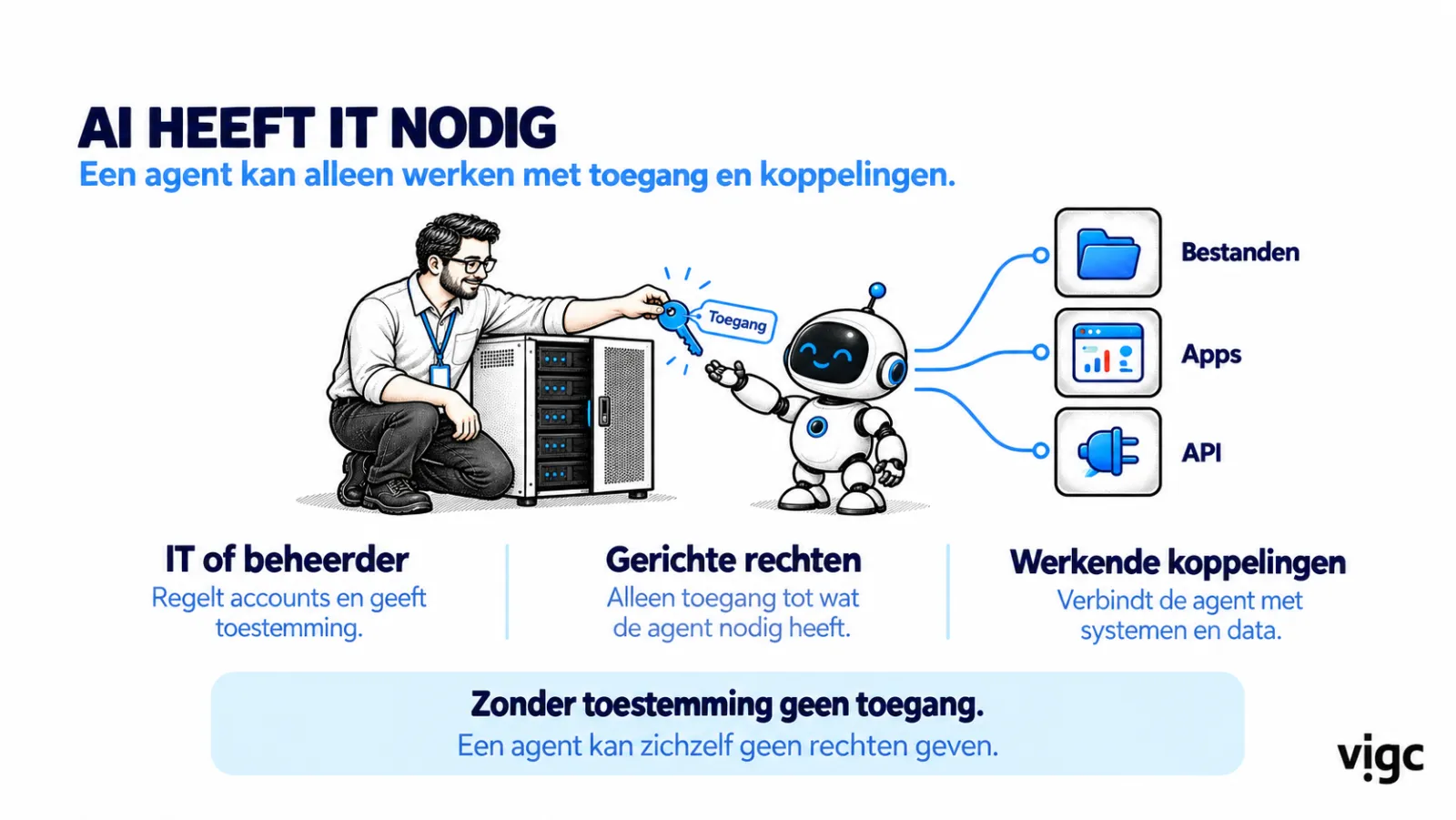
An AI assistant that prepares orders must be able to get into your order system. An agent that proposes planning needs your calendar and your machine data. You do not arrange that with a prompt. The IT manager or the administrator arranges that.
Manages accounts and grants permission. In a small printing company that is often an external partner. Involve them from the start.
The agent only gets access to what it needs. An assistant that reads emails does not need to see your accounts.
The agent has to connect to files and systems. How that works is covered in guide 02 on MCP and guide 09 on APIs.
Keep track of which agent has which rights and who granted them. Is an application leaving the pilot phase? Then go through that list again.
The whole team on board
AI only works when the team understands it together. You learn a task by doing it and by explaining it to a colleague.
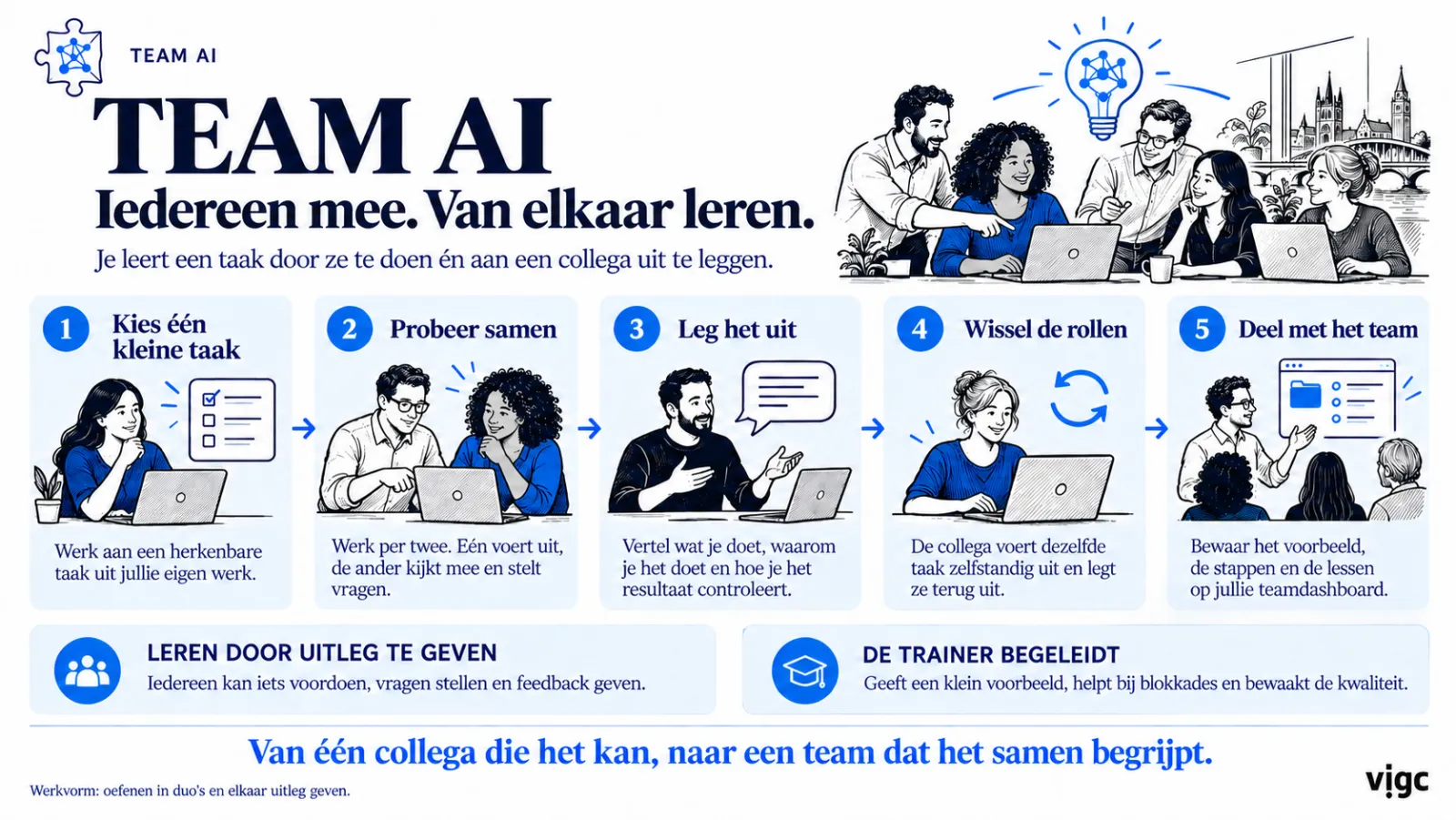
In many printing companies there is one colleague who is already good with AI. That is a good start. The risk is that all the knowledge stays with that one person. Five steps let you share it.
Work on a recognisable task from your own work.
Work in pairs. One does the task, the other watches and asks questions.
Say what you are doing and why. Also show how you check the result.
The colleague does the same task independently and explains it back.
Keep the example and the lessons in a place everyone knows.
So governance is also a matter of people. A policy that only the business owner knows steers nothing. A team that knows what AI may do and how to check it steers along every day.
Further reading and sources
This guide rests on the first slides of the VIGC training “Bouw je eigen AI-machine” (build your own AI machine). The figures were checked against the sources below on 30 September 2026. The order email example is fictional. The questions for an AI policy and the three gates applied to a printing company are advice from the project team.
55% of large EU companies and 20% of all companies with 10 or more employees, 2025 data, surveyed sectors.
56% of 4,454 CEOs saw no higher revenue and no lower costs from AI in the past 12 months. Survey September to November 2025.
31% of 561 European business and IT professionals report a formal, comprehensive AI policy. Survey March to April 2025.
Prediction: 25% better business results in 2028 for those who adopt and sustain an AI-first strategy.
Value requires coherence between AI, data, analysis and governance (17 June 2025).
Prediction: more than 40% of projects with AI agents cancelled by the end of 2027 (June 2025).
The core of a neural network in about one hundred and fifty lines of code.
The three-day training these slides come from.
Building a first small assistant, without programming.
AI does not deliver value by itself. Choose a goal and start small. People decide.