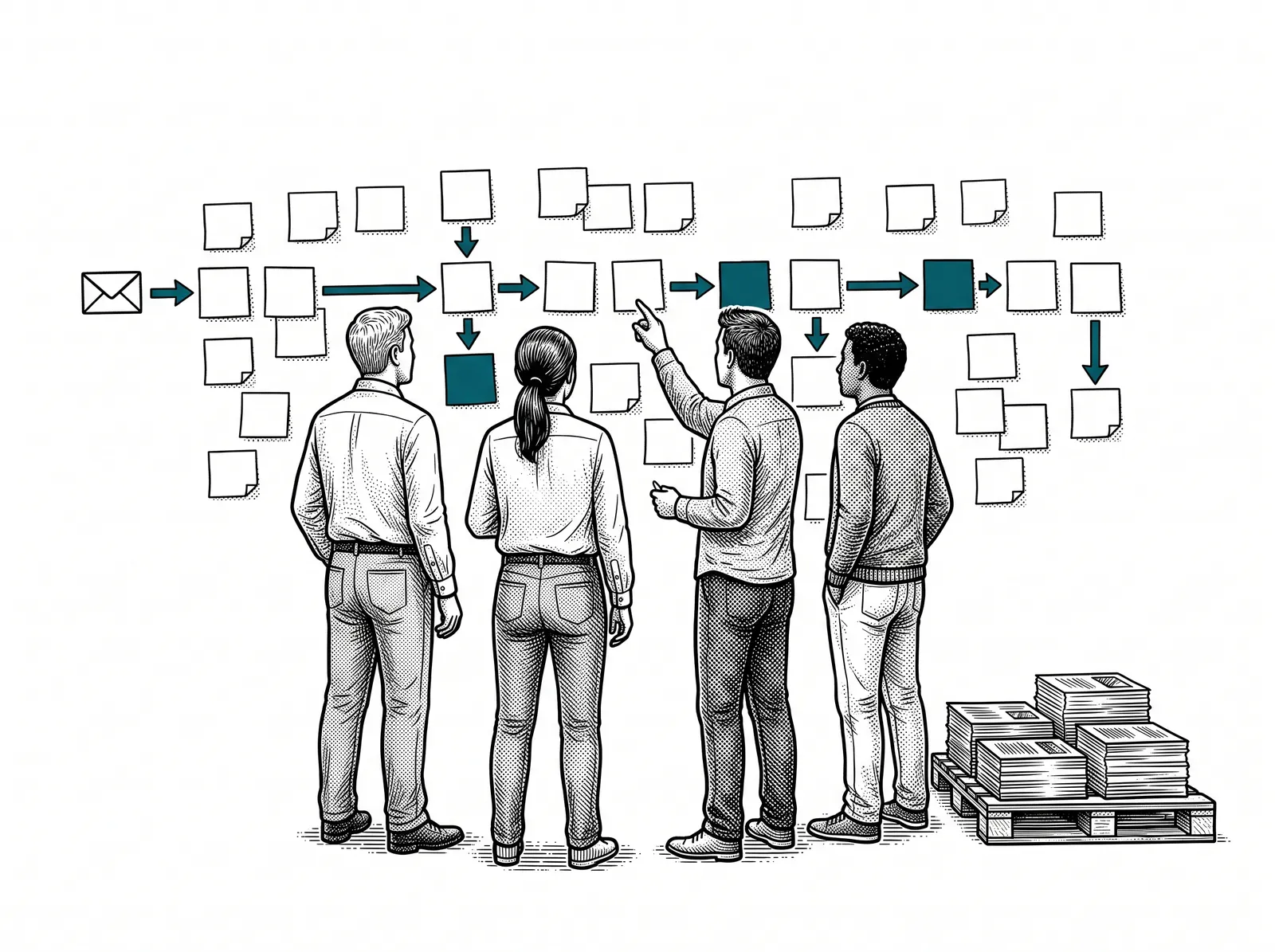
Where is the pain, where does the data stop, where is it retyped and why are paper job tickets still going round between estimating, prepress, the press and finishing? Those puzzles have to be solved first. AI projects become expensive and fail because there is no plan before the building starts.
Who it is for
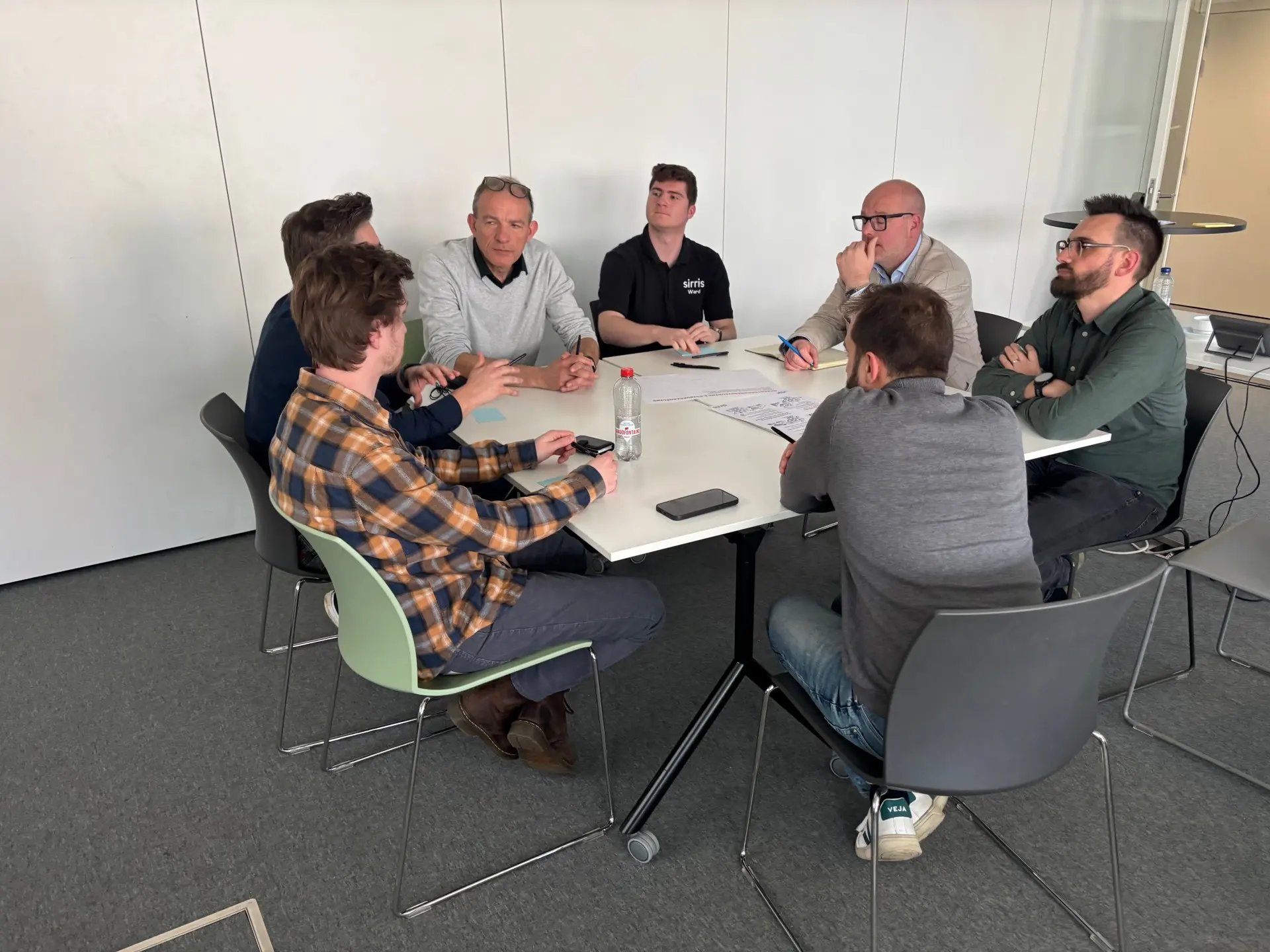
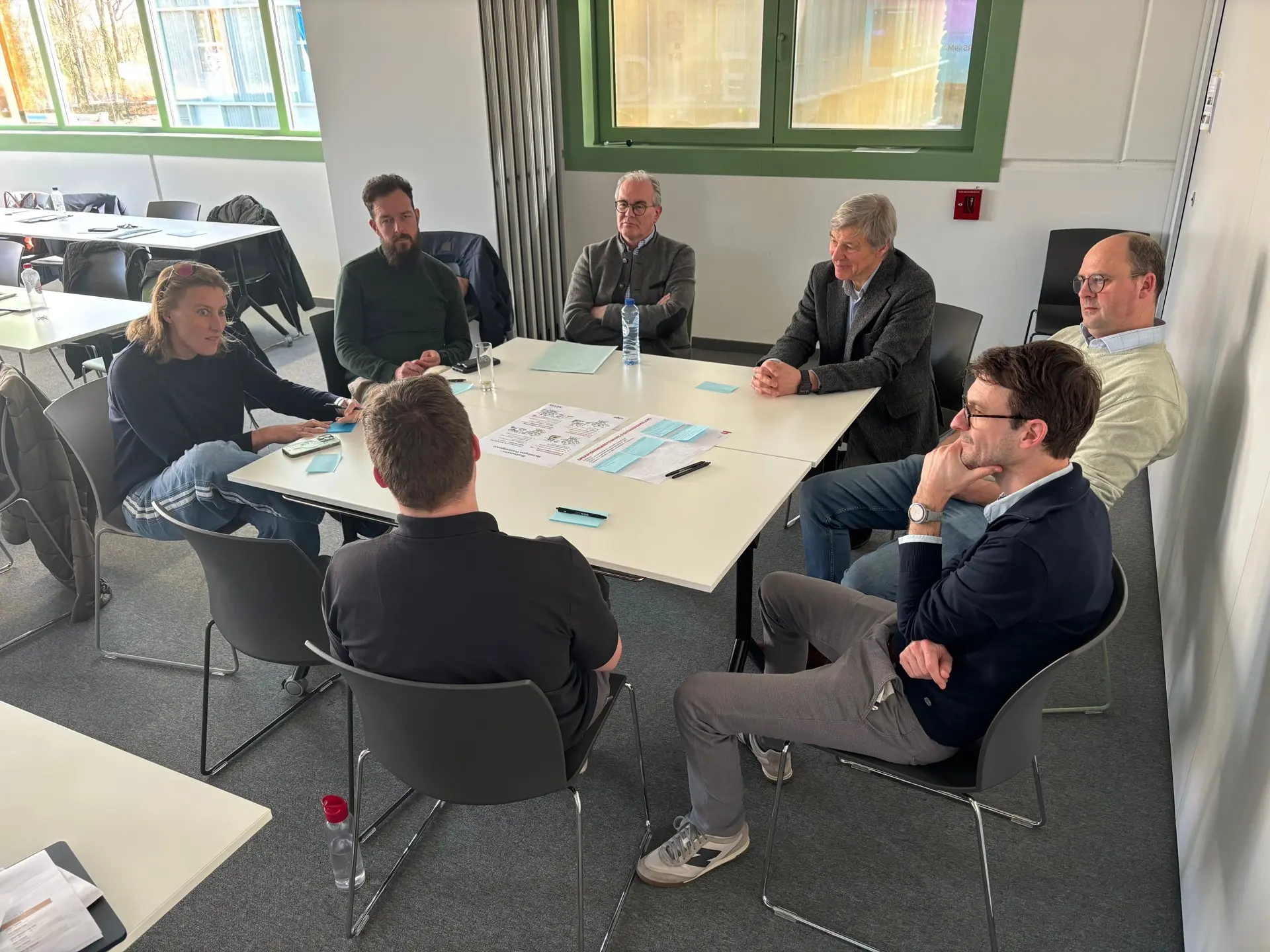
On this day the whole team sits round the table: the business owner and someone from estimating, prepress, press, finishing and dispatch. Together you follow real orders from the customer's request to delivery. That makes visible where the information flows smoothly and where it gets stuck.
The team builds the map itself and writes the plan itself. AI is the accelerator: in one day you see what otherwise takes weeks of analysis, and you see it on your own orders.
How the day goes
One day, six stops. Everything happens on the day itself: no questionnaire beforehand, no pre-drawn flow. The team makes the map, the team writes the plan.
Why map first
A short framework to open the day. Why do AI projects become expensive and why do they fail? There is no plan before the building starts. The data they have to run on also stops somewhere along the way: in a paper job ticket or in an email that gets retyped. Sometimes it only sits in the head of one colleague. You solve those puzzles first. Then the screen goes on and the wall opens up.
On the wall: following real orders
Three orders from your own company on the table, a simple one and a difficult one among them. For each order the team tells what happens step by step and puts it on the wall: who does it, in which system, what comes in and what goes out. Every place where something is retyped or where knowledge sits in one head gets its own colour. The same goes for every place where someone waits for someone else. The discussion at the wall is the work.
From the wall to the map
The team transfers the wall itself into Obsidian on the big screen: every step a node and every handover an arrow. Every stop goes in red. That is where the picture gets sharp. For the first time you see the whole flow from customer email to pallet at a glance, and everyone at the table recognises their own part.
What is AI, and what is just an integration
With the map on the screen we look per stop at what is really needed. Often it is not AI but a data link or a plain query on what is already in the system. Scripting has existed for a long time in a graphic arts environment: think of hot folders, or of JDF and XJDF connecting the MIS with prepress and the press. We explain what a modern API connection does differently. You also see where AI only starts to make sense: where information sits in text or in images and nobody reads it today, such as in an email.
The plan: do it yourself, buy it or have it connected
AI reads the map and tells what it sees: where the information stops, what weighs heaviest and what may be tackled first. The team corrects and decides, per stop: do we do this ourselves, do we buy a solution that already exists, or do we have a supplier connect it. Building it yourself often costs more than buying something that already exists, and sometimes it is the other way round. That produces a plan in phases: first try out, then pilot, then roll out, with for each step someone from the team who owns it.
The report, by the team itself
The team lets AI build the report from the map and the plan, reads it through and goes home with a document that is theirs. We close with the question of how you do this again yourselves on a next flow, without guidance.

What the team has afterwards
When you walk out after this day nothing has been built, and that is the intention. What there is, is something that makes building possible:
- A map of your own company, made by the people who do the work, from customer email to pallet.
- A shared picture of where the information stops, why, and what that costs.
- A plan in phases with for each step someone who owns it, written by the team itself.
- Per stop a decision: do it yourself, buy what already exists, or have a supplier connect it.
- The insight into when AI is needed and when a data link or a plain query is enough.
- A report that is yours, ready to show to the rest of the company.
- A way of looking that you can repeat yourselves on another flow.
- An answer to the question of which of the other trainings makes sense afterwards, and for whom.
This is ready when you walk out
- The map in Obsidian, with a short legend, to build on yourselves
- The plan in phases with owners
- The report as a PDF
- A page with the method in steps, to repeat without guidance
After this day the team knows where it stands, what it does itself and what it buys, and starts building on solid ground.

Practical
- Duration
- 1 day, from 09:00 to 17:00, at your premises.
- Approach
- The team does the work, the trainer guides. Morning at the wall, afternoon on the screen with Obsidian and AI. No prior knowledge needed, no laptop per person.
- Who sits at the table
- The business owner and one person per department: estimating or customer service, prepress, press, finishing, dispatch, administration. Five to eight people. The people who do the work have to be there: they will carry the plan later.
- What to prepare
- Three real orders from the past months, from the customer's request to the invoice: a simple one, a difficult one and a typical one. A wall or large board, post-its, and a projector or large screen.
- Tools
- The trainer brings a laptop with Obsidian and AI. The team takes the map and the report home after the day, with a short explanation to carry on with it yourselves.
- Printelligence
- For companies in the Printelligence programme or the steering group this day is included in the programme. Other companies request a quote.
Want to see what data in a printing company tells you? Read the story of POC 1 at Drukkerij Moderna or the guide What is an API.