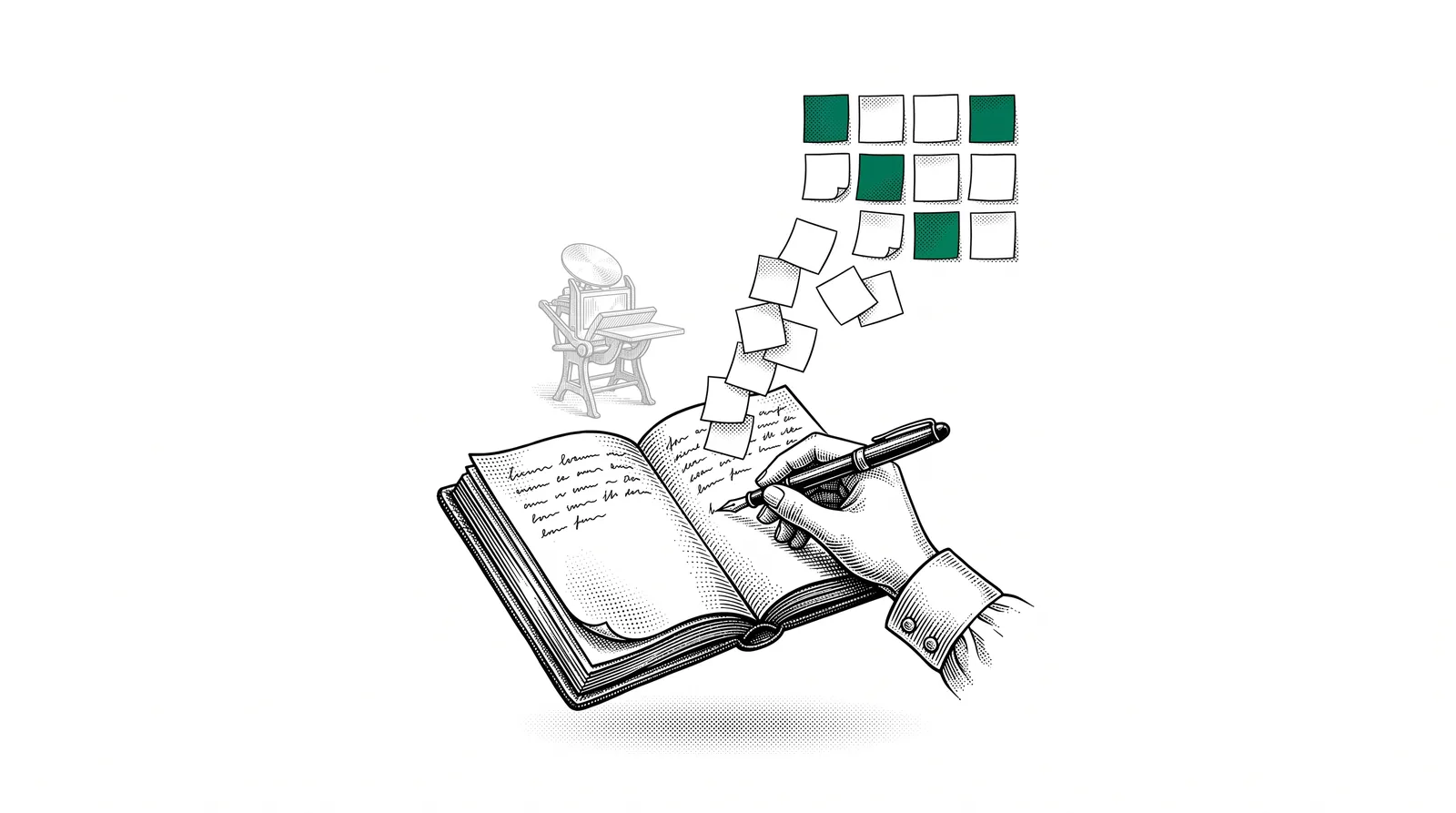
The first proof-of-concept of PRINTELLIGENCE ran at Drukkerij Moderna, a printing company with web presses and sheetfed offset. The question was simple: what can AI do today with the data a printing company already has? The answer came from an unexpected corner. Not the machine data but the reports operators have been typing in for twenty years turned out to be the richest source.
Access first
The starting point was a SWAiP scan by VIGC in the spring. It mapped where the company stands and which systems are running. After that it came down to the question which data we could reach and who grants access to it. Every connection is read-only: the AI looks along but changes nothing in the production systems.
ERP and planning
A feasibility study with The Shell Company showed that a modern read-only API on top of the existing ERP database works. A migration to another ERP turned out to be unnecessary.
Machine data
The manroland web presses log stoppages and web breaks to the minute. For the Heidelberg sheetfed press that runs through the Prinect API.
Operator reports
A logbook in which press operators have noted since 2001 what went wrong with every production run. Free text, typed at the press. This became the core of the trial.


Twenty years of experience in free text
The logbook holds more than a hundred thousand reports from dozens of press operators. The same fault appears in very different wordings. The AI read them in full and grouped them into recurring problems per press. Then we laid each category next to the machine data and the figures from the ERP.
The machine“fault: overtemperature zone 31”
The operator“every single time it is warm outside”
Sensors register what happens. Operators describe what they see. The outcome of that comparison was striking: nowhere did the machine data contradict the reports of the press operators. What the operators had written down for years was right.
At the same time it turned out that the logging stopped in 2025. Whoever reports without ever getting an answer stops after a while. The feedback loop between shop floor and office was broken. That is not a data question but an agreement on the floor.
What it delivers
The analysis resulted in an action plan of more than fifty pages with priorities and an expected return per action. These are proposals and hypotheses. The printing company tests them in practice itself, no saving has been realised yet. Five recommendations stand out:
- 1Restore the fountain roller control on the press where it produces the most machine events.
- 2Optimise the washing unit. On one press the blanket washing unit is the biggest source of downtime.
- 3Shorten makeready time with a fixed approach to setting up.
- 4Improve the reel change where breaks still peak right after the splice.
- 5Follow up every report. A weekly triage with an answer back to the operator.

What the printing company built itself
The best result is that the printing company got to work itself. On its own in-house AI server the team built a series of small applications with Claude Code, all read-only on the ERP and the machine data. The most important one is a digital shop floor data capture that has been live since September 2026. The operator clocks at the machine what he is doing and gets immediate feedback: how far the run has progressed and how fast the press is running compared to the estimate. If the press stands still for five minutes without a report, the screen asks what is wrong.
In addition there is now a finishing monitor that puts planned and actual side by side. A post-calculation that compares the estimate with what was really measured is in the test phase.

What the industry learns from it
- Listen to your operators. Their reports are not noise. They add the experience no sensor measures.
- Close the loop. A report without follow-up costs you the report itself in the long run.
- Start with what you have. Many printing companies have years of data sitting in old logbooks and databases. Read-only connections make it usable without risk to production.
- Let the team build it themselves. With today's AI tools an employee can make applications in a few weeks that used to be a software project.
Want to take part?
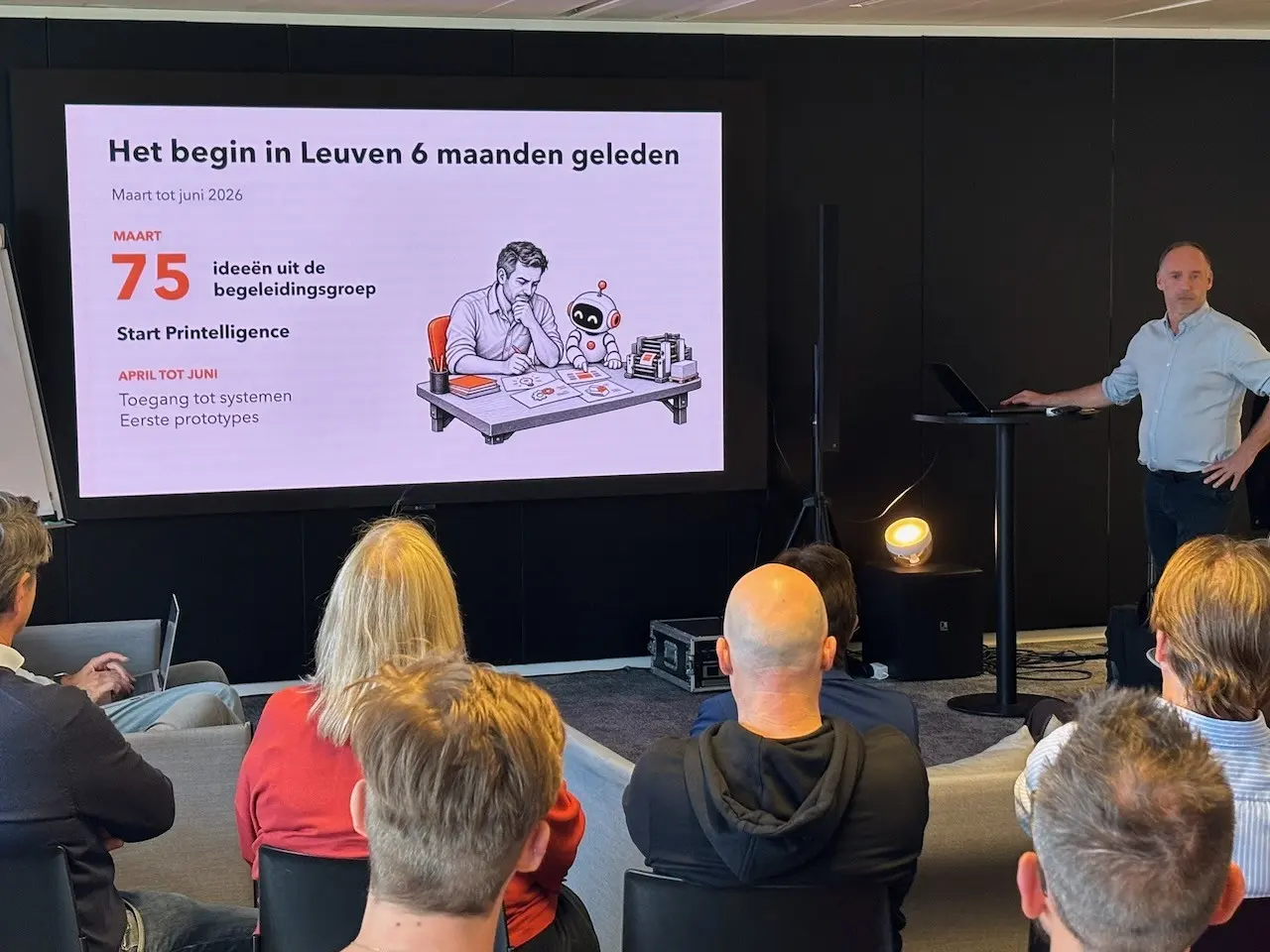
The results of this trial will be shown live at the demo and workshop of 18 November in Genk. Do you have a production problem of your own with the data to go with it? Let us know, perhaps your company becomes the next proof-of-concept.
